Mobile Supported Video

  • Subscribe to our RSS feed.
  • Twitter
  • StumbleUpon
  • Reddit
  • Facebook
  • Digg

Friday, 29 November 2013

New lithium-ion battery design that’s 2,000 times more powerful, recharges 1,000 times faster

Posted on 05:41 by Unknown
University of Illinois, 3D porous microstructure lithium-ion battery
Researchers at the University of Illinois at Urbana-Champaign have developed a new lithium-ion battery technology that is 2,000 times more powerful than comparable batteries. According to the researchers, this is not simply an evolutionary step in battery tech, “It’s a new enabling technology… it breaks the normal paradigms of energy sources. It’s allowing us to do different, new things.”
Currently, energy storage is all about trade-offs. You can have lots of power (watts), or lots of energy (watt-hours), but you can’t generally have both. Supercapacitors can release a massive amount of power, but only for a few seconds; fuel cells can store a vast amount of energy, but are limited in their peak power output. This a problem because most modern applications of bleeding-edge tech — smartphones, wearable computers, electric vehicles — require large amounts of power and energy. Lithium-ion batteries are currently the best solution for high-power-and-energy applications, but even the best li-ion battery designs demand that industrial designers and electronic engineers make serious trade-offs when creating a new device.
Which brings us neatly onto the University of Illinois’ battery, which has a higher power density than a supercapacitor, and yet comparable energy density to current nickel-zinc and lithium-ion batteries. According to the university’s press release, this new battery could allow for wireless devices to transmit their signals 30 times farther — or, perhaps more usefully, be equipped with a battery that’s 30 times smaller. If that wasn’t enough, this new battery is rechargeable – and can be charged 1,000 times faster than conventional li-ion batteries. In short, this is a dream battery. (See: DoE calls for a chemical battery with 5x capacity, within 5 years – can it be done?)
Diagram illustrating the University of Illinois' 3D anode/cathode fabrication
These huge advances stem from a brand new cathode and anode structure, pioneered by the University of Illinois researchers. In essence, a standard li-ion battery normally has a solid, two-dimensional anode made of graphite and a cathode made of a lithium salt. The new Illinois battery, on the other hand, has a porous, three-dimensional anode and cathode. To create this new electrode structure, the researchers build up a structure of polystyrene (Styrofoam) on a glass substrate, electrodeposit nickel onto the polystyrene, and then electrodeposit nickel-tin onto the anode and manganese dioxide onto the cathode. The diagram above does a good job of explaining the process.
The end result is that these porous electrodes have a massive surface area, allowing for more chemical reactions to take place in a given space, ultimately providing a massive boost to discharge speed (power output) and charging. So far, the researchers have used this tech to create a button-sized microbattery, and you can see in the graph below how well their battery compares to a conventional Sony CR1620 button cell. The energy density is slightly lower, but the power density is 2,000 times greater. On the opposite end of the bleeding-edge spectrum — increased energy density, but lower power density — thenIBM’s lithium-air battery currently leads the pack.
Energy density vs. power density for a variety of battery technologies, including University of Illinois' new microstructured anode/cathode li-ion battery
Energy density vs. power density for a variety of battery technologies, including University of Illinois’ new microstructured anode/cathode li-ion battery
In real-world use, this tech will probably be used to equip consumer devices with batteries that are much smaller and lighter — imagine a smartphone with a battery the thickness of a credit card, which can be recharged in a few seconds. There will also be plenty of applications outside the consumer space, in high-powered settings such as lasers and medical devices, and other areas that normally use supercapacitors, such as Formula 1 cars and fast-recharge power tools. For this to occur, though, the University of Illinois will first have to prove that their technology scales to larger battery sizes, and that the production process isn’t prohibitively expensive for commercial production. Here’s hoping.
Read More
Posted in | No comments

Single-Layer Tin Could Go Beyond Graphene, Conducting Electricity with 100% Efficiency

Posted on 05:15 by Unknown
2D Tin Could Be Next Super Material, Say Theorists

A single layer of tin atoms could be the world’s first material to conduct electricity with 100% efficiency at the temperatures that computer chips operate, according to a team of theoretical physicists led by researchers from the U.S. department of energy’s (DOE) SLAC national accelerator naboratory and Stanford University. Researchers call the new material “stanene”, combining the Latin name for tin (stannum) with the suffix used in graphene, another innovative single-layer material.
"Stanene could increase the speed and lower the power needs of future generations of computer chips, if our prediction is confirmed by experiments that are underway in several laboratories around the world," said the team leader, Shoucheng Zhang, a physics professor at Stanford and the Stanford Institute for Materials and Energy Sciences (SIMES), a joint institute with SLAC.

The Path to Stanene

For the past decade, Shoucheng Zhang and colleagues have been calculating and predicting the electronic properties of a special class of materials known as topological insulators, which conduct electricity only on their outside edges or surfaces and not through their interiors. When topological insulators are just one atom thick, their edges conduct electricity with 100% efficiency. These unusual properties result from complex interactions between the electrons and nuclei of heavy atoms in the materials.
“The magic of topological insulators is that by their very nature, they force electrons to move in defined lanes without any speed limit, like the German autobahn. As long as they’re on the freeway – the edges or surfaces – the electrons will travel without resistance,” said Mr. Zhang.
In 2006 and 2009, Mr. Zhang’s group predicted that mercury telluride and several combinations of bismuth, antimony, selenium and tellurium should be topological insulators, and they were soon proven right in experiments performed by others. But none of those materials is a perfect conductor of electricity at room temperature, limiting their potential for commercial applications.

Earlier this year, visiting scientist Yong Xu, who is now at Tsinghua University in Beijing, collaborated with Zhang’s group to consider the properties of a single layer of pure tin.
“We knew we should be looking at elements in the lower-right portion of the periodic table. All previous topological insulators have involved the heavy and electron-rich elements located there,” said Mr. Xu.
Adding fluorine atoms (yellow) to a single layer of tin atoms (grey) should allow a predicted new material, stanene, to conduct electricity perfectly along its edges (blue and red arrows) at temperatures up to 100°C (212°Fahrenheit).
Their calculations indicated that a single layer of tin would be a topological insulator at and above room temperature, and that adding fluorine atoms to the tin would extend its operating range to at least 100°C (212°Fahrenheit).


Ultimately a Substitute for Silicon?

Mr. Zhang said the first application for this stanene-fluorine combination could be in wiring that connects the many sections of a microprocessor, allowing electrons to flow as freely as cars on a highway. Traffic congestion would still occur at on- and off-ramps made of conventional conductors, he said. But stanene wiring should significantly reduce the power consumption and heat production of microprocessors.
Manufacturing challenges include ensuring that only a single layer of tin is deposited and keeping that single layer intact during high-temperature chip-making processes.
“Eventually, we can imagine stanene being used for many more circuit structures, including replacing silicon in the hearts of transistors. Someday we might even call this area Tin Valley rather than Silicon Valley,” said Mr. Zhang.
Read More
Posted in | No comments

Thursday, 21 November 2013

Qualcomm Unleashes High-End Mobile Application Processor with 4K Video Support.

Posted on 23:51 by Unknown

Qualcomm Introduces Snapdragon 805 System-on-Chip 

Four Cores, New Graphics, Quad-Channel Memory, New Technologies
Qualcomm, the world’s largest developer of mobile application processors, a new Snapdragon 800-series system-on-chip that features vastly improved performance and capabilities. The new processor is among the world’s first SoCs to support video in ultra-high-definition (UHD) resolutions and formats. Qualcomm Snapdragon 805 application processor promises to become the world’s fastest mobile chip to date.

Qualcomm Snapdragon 805 features four ARM Krait 450 cores designed to work at 2.50GHz; Adreno 420 graphics processing engine that supports hardware tessellation and geometry shaders as well as provides 40% higher performance than the predecessor; quad-channel LPDDR3 memory controller with up to 25.6GB/s bandwidth; and a number of other innovations, such as new special-purpose multimedia accelerators, enhanced dual camera image signal processors (ISPs) and so on. The chip does not feature baseband capabilities, but supports WiFi 802.11n/ac (2.4 and 5GHz) and Bluetooth 4.0.

Qualcomm Snapdragon 805 can be paired with Qualcomm Gobi MDM9x25 or the Gobi MDM9x35 modem, powering superior seamless connected mobile experiences. The Gobi MDM9x25 chipset announced in February 2013 has seen significant adoption as the first embedded, mobile computing solution to support 4G/LTE carrier aggregation and LTE Category 4 with superior peak data rates of up to 150Mb/s. Additionally, Qualcomm’s most advanced Wi-Fi for mobile, 2-stream dual-band Qualcomm VIVE 802.11ac, enables wireless 4K video streaming and other media-intensive applications. With a low-power PCIe interface to the QCA6174, tablets and high-end smartphones can take advantage of faster mobile Wi-Fi performance (over 600Mb/s), extended operating range and concurrent Bluetooth connections, with minimal impact on battery life.


“Using a smartphone or tablet powered by Snapdragon 805 processor is like having an UltraHD home theater in your pocket, with 4K video, imaging and graphics, all built for mobile. We are delivering the mobile industry’s first truly end-to-end Ultra HD solution, and coupled with our industry leading Gobi LTE modems and RF transceivers, streaming and watching content at 4K resolution will finally be possible,” said Murthy Renduchintala, executive vice president, Qualcomm Technologies.

The Snapdragon 805 processor is sampling now and expected to be available in commercial devices by the first half of 2014.
Read More
Posted in | No comments

Tuesday, 5 November 2013

Synaptic Transistor Learns While It Computes

Posted on 01:03 by Unknown
Our brains have upwards of 86 billion neurons, connected by synapses that not only complete myriad logic circuits; they continuously adapt to stimuli, strengthening some connections while weakening others. We call that process learning, and it enables the kind of rapid, highly efficient computational processes that put Siri and Blue Gene to shame.
Materials scientists at the Harvard School of Engineering and Applied Sciences (SEAS) have now created a new type of transistor that mimics the behavior of a synapse. The novel device simultaneously modulates the flow of information in a circuit and physically adapts to changing signals.

Exploiting unusual properties in modern materials, the synaptic transistor could mark the beginning of a new kind of artificial intelligence: one embedded not in smart algorithms but in the very architecture of a computer. The findings appear in Nature Communications.

"There's extraordinary interest in building energy-efficient electronics these days," says principal investigator Shriram Ramanathan, associate professor of materials science at Harvard SEAS. "Historically, people have been focused on speed, but with speed comes the penalty of power dissipation. With electronics becoming more and more powerful and ubiquitous, you could have a huge impact by cutting down the amount of energy they consume."

The human mind, for all its phenomenal computing power, runs on roughly 20 Watts of energy (less than a household light bulb), so it offers a natural model for engineers.
"The transistor we've demonstrated is really an analog to the synapse in our brains," says co-lead author Jian Shi, a postdoctoral fellow at SEAS. "Each time a neuron initiates an action and another neuron reacts, the synapse between them increases the strength of its connection. And the faster the neurons spike each time, the stronger the synaptic connection. Essentially, it memorizes the action between the neurons."

In principle, a system integrating millions of tiny synaptic transistors and neuron terminals could take parallel computing into a new era of ultra-efficient high performance.
While calcium ions and receptors effect a change in a biological synapse, the artificial version achieves the same plasticity with oxygen ions. When a voltage is applied, these ions slip in and out of the crystal lattice of a very thin (80-nanometer) film of samarium nickelate, which acts as the synapse channel between two platinum "axon" and "dendrite" terminals. The varying concentration of ions in the nickelate raises or lowers its conductance — that is, its ability to carry information on an electrical current — and, just as in a natural synapse, the strength of the connection depends on the time delay in the electrical signal.

Structurally, the device consists of the nickelate semiconductor sandwiched between two platinum electrodes and adjacent to a small pocket of ionic liquid. An external circuit multiplexer converts the time delay into a magnitude of voltage which it applies to the ionic liquid, creating an electric field that either drives ions into the nickelate or removes them. The entire device, just a few hundred microns long, is embedded in a silicon chip.
The synaptic transistor offers several immediate advantages over traditional silicon transistors. For a start, it is not restricted to the binary system of ones and zeros.
Read More
Posted in | No comments

Tuesday, 20 March 2012

Holey Optochip First to Transfer One Trillion Bits of Information per Second Using the Power of Light developed by IBM

Posted on 01:46 by Unknown

IBM scientists today reported of a prototype optical chipset, dubbed “Holey Optochip”, that is the first parallel optical transceiver to transfer one trillion bits – one terabit – of information per second, the equivalent of downloading 500 high definition movies. The report will be presented at the Optical Fiber Communication Conference taking place in Los Angeles.
With the ability to move information at blazing speeds – eight times faster than parallel optical components available today – the breakthrough could transform how data is accessed, shared and used for a new era of communications, computing and entertainment. The raw speed of one transceiver is equivalent to the bandwidth consumed by 100,000 users at today’s typical 10 Mb/s high-speed internet access. Or, it would take just around an hour to transfer the entire U.S. Library of Congress web archive through the transceiver.  
Progress in optical communications is being driven by an explosion of new applications and services as the amount of data being created and transmitted over corporate and consumer networks continues to grow. At one terabit per second, IBM’s latest advance in optical chip technology provides unprecedented amounts of bandwidth that could one day ship loads of data such as posts to social media sites, digital pictures and videos posted online, sensors used to gather climate information, and transaction records of online purchases.  
“Reaching the one trillion bit per second mark with the Holey Optochip marks IBM’s latest milestone to develop chip-scale transceivers that can handle the volume of traffic in the era of big data,” said IBM Researcher Clint Schow, part of the team that built the prototype. “We have been actively pursuing higher levels of integration, power efficiency and performance for all the optical components through packaging and circuit innovations. We aim to improve on the technology for commercialization in the next decade with the collaboration of manufacturing partners.”  
Optical networking offers the potential to significantly improve data transfer rates by speeding the flow of data using light pulses, instead of sending electrons over wires. Because of this, researchers have been looking for ways to make use of optical signals within standard low-cost, high-volume chip manufacturing techniques for widespread use. 
Holey Optochip
Photomicrograph of IBM Holey Optochip. Original chip dimensions are 5.2 mm x 5 .8 mm.
Using a novel approach, scientists in IBM labs developed the Holey Optochip by fabricating 48 holes through a standard silicon CMOS chip. The holes allow optical access through the back of the chip to 24 receiver and 24 transmitter channels to produce an ultra-compact, high-performing and power-efficient optical module capable of record setting data transfer rates. 
The compactness and capacity of optical communication has become indispensable in the design of large data-handling systems. With that in mind, the Holey Optochip module is constructed with components that are commercially available today, providing the possibility to manufacture at economies of scale. 
Consistent with green computing initiatives, the Holey Optochip achieves record speed at a power efficiency (the amount of power required to transmit a bit of information) that is among the best ever reported. The transceiver consumes less than five watts; the power consumed by a 100W light bulb could power 20 transceivers. This progress in power efficient interconnects is necessary to allow companies who adopt high-performance computing to manage their energy load while performing powerful applications such as analytics, data modeling and forecasting. 
By demonstrating unparalleled levels of performance, the Holey Optochip illustrates that high-speed, low-power interconnects are feasible in the near term and optical is the only transmission medium that can stay ahead of the accelerating global demand for broadband. The future of computing will rely heavily on optical chip technology to facilitate the growth of big data and cloud computing and the drive for next-generation data center applications.
Technical Aspects of the Holey Optochip
Back of Holey Optochip
Photomicrograph of the back of the IBM Holey Optochip with lasers and photodectors visible through substrate holes.  
Parallel optics is a fiber optic technology primarily targeted for high-data, short-reach multimode fiber systems that are typically less than 150 meters. Parallel optics differs from traditional duplex fiber optic serial communication in that data is simultaneously transmitted and received over multiple optical fibers. 
A single 90-nanometer IBM CMOS transceiver IC with 24 receiver and 24 transmitter circuits becomes a Holey Optochip with the fabrication of forty-eight through-silicon holes, or “optical vias” – one for each transmitter and receiver channel. Simple post-processing on completed CMOS wafers with all devices and standard wiring levels results in an entire wafer populated with Holey Optochips. The transceiver chip measures only 5.2 mm x 5.8 mm. Twenty-four channel, industry-standard 850-nm VCSEL (vertical cavity surface emitting laser) and photodiode arrays are directly flip-chip soldered to the Optochip. This direct packaging produces high-performance, chip-scale optical engines. The Holey Optochips are designed for direct coupling to a standard 48-channel multimode fiber array through an efficient microlens optical system that can be assembled with conventional high-volume packaging tools. 
Read More
Posted in | No comments

Tuesday, 21 February 2012

Fully Laser Integrated Photonics (FLIP) - A revolution in Computing Technology on the edge

Posted on 00:19 by Unknown
Fully Laser Integrated Photonics (FLIP) may replace conventional electronics in a whole lot of computing and cut down computing's ever-rising demand for power (Google today already accounts for 1% of US power consumption) by an order of magnitude. 

It is as fast as lightning, it is cool, it is going to change the world as fundamentally as did manned flight and it has been created by an Indian, Raj Dutt... Okay, Stanford, Massachusetts Institute of Technology and the US Navy chipped in. 

FLIP has been enabled by a breakthrough in the science of materials just announced in the US: Indian American scientist and entrepreneur Dr Birendra (Raj) Dutt along with a top team of researchers at his own company APIC Corporation, the Massachusetts Institute of Technology and Stanford University has discovered how to make germanium produce a laser when charged with electricity. This would eventually allow a new breed of microchips to be built on a commercial scale in which pulses of light, called photons, zip at top speed along nano-sized waveguides of the self-same germanium etched into silicon, instead of electrons whizzing around in copper circuits on silicon as in today's chips. 

When electrons move through a conductor, they produce heat, which then has to be removed using additional energy. Photons, on the other hand, do not produce heat as they move through their waveguides at the speed of light, hence no energy is required to cool photonic chips. Further, use of doped germanium together with the straining of this material when grown on silicon produces a laser that makes mass commercial production of photonic chips possible. 


Germanium belongs to the same group of elements as silicon, making full integration of laser chips possible. While use of photons in chips is not new, till the present discovery of making germanium 'lase', it had not been possible to have integrated photon chips. Dr Dutt, an IIT-Kharagpur, aeronautical engineering alumnus of the class of 1971, founded APIC Corporation in 1999 for research, development and production of highly integrated photonic and electronic technology. Today his company has forged strategic relationships with a large number of universities and institutions in the US. It has a wholly-owned fabrication facility in Honolulu. The breakthrough research, which was achieved under a US government contract, was sponsored by the Naval Air Systems Command, Aircraft Division,(NAVAIR) and the National Security Agency (NSA) and funded by the US department of defence. 


Dr Dutt, founder and chief technology officer of APIC and the principal investigator on this project, along with his co-investigator, Dr Jurgen Michel, senior research scientist at Massachusetts Institute of Technology, succeeded in getting germanium, which is a group IV material that is silicon CMOS compatible, to lase when electrically pumped."Both the scientific community and industry have been waiting for a breakthrough like this. The new photonic chips will have exponentially better performance at a tiny fraction of current power usage, and a tremendous positive impact on the environment through drastic reduction of heat generated by computing devices," Dr Dutt told ET from his office in Culver City, California. 

Experts in the US are upbeat about APIC's research. Dr. Tony Tether, former director of Defence Advanced Projects Research Agency (DARPA), the US agency responsible for development of new technology for use by the military has stated that, "The APIC FLIP effort has achieved creating a germanium LASER heretofore thought to be impossible. Take these results as the Kitty Hawk demonstration where it was shown that manned flight was possible." 

APIC now plans to commercially roll-out the fully manufacturable prototype of the photonic chip over the next 18-24 months and has teamed up with R&D fabrication facility at the College of Nanoscale Science and Engineering at the University of Albany in New York state. "The performance increase comes with a stunning decrease in the amount of power needed as compared to today's chips. Voracious demand for online and mobile services, along with cloud computing, has caused explosive growth in the amount of data centres and the energy they gobble up. But photons simply require much less power than electrons to propel, and most importantly they do not generate heat. Using photonic processors and components would enable massive energy savings for data centres, which would consume only about 10% of today," Dr Dutt added. 

Once the chip has been commercially launched, APIC Corporation could look at tie-ups with other chip makers for production. The company, which is a US government contractor, owns the patent for the photon chip technology and Dr Dutt believes that there could be opportunities in the future to look at tie-ups with institutions in India for making the photon-chip.
Read More
Posted in | No comments

Monday, 6 February 2012

Bamboo-inspired Plantbook concept powered by self-generated hydrogen

Posted on 04:46 by Unknown
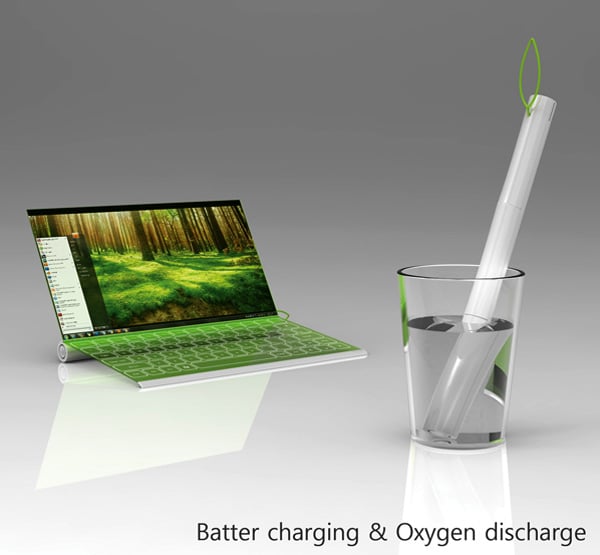
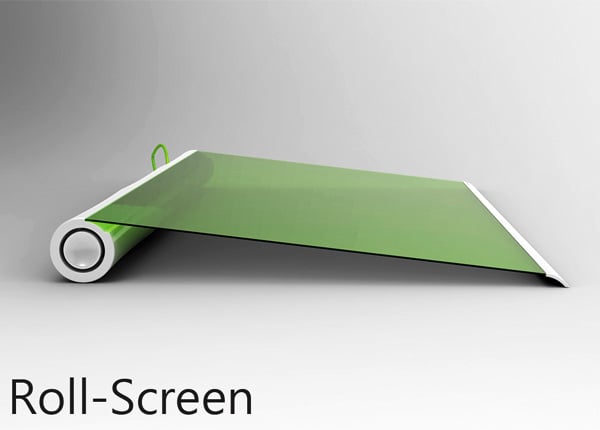
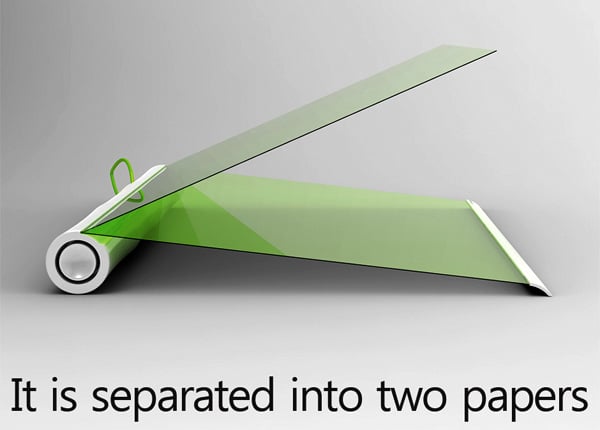
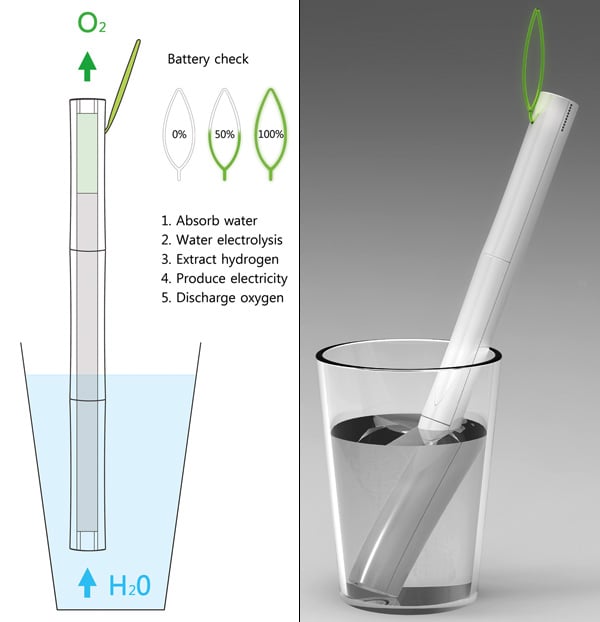
The Plantbook or the 'oxygenated notebook', a concept designed by Seunggi Baek and Hyerim Kim, is a laptop whose technology is largely inspired by the bamboo plant that derives its nutrients when soaked in water. The design of Plantbook is amazing and unique. It comprises of a cylindrical structure with two rollout screens (for the keyboard and monitor). The green color of the notebook is a representation of its 'green' capabilities. There is no need for you to charge the notebook as it uses hydrogen generated by electrolysis of water as its energy source.
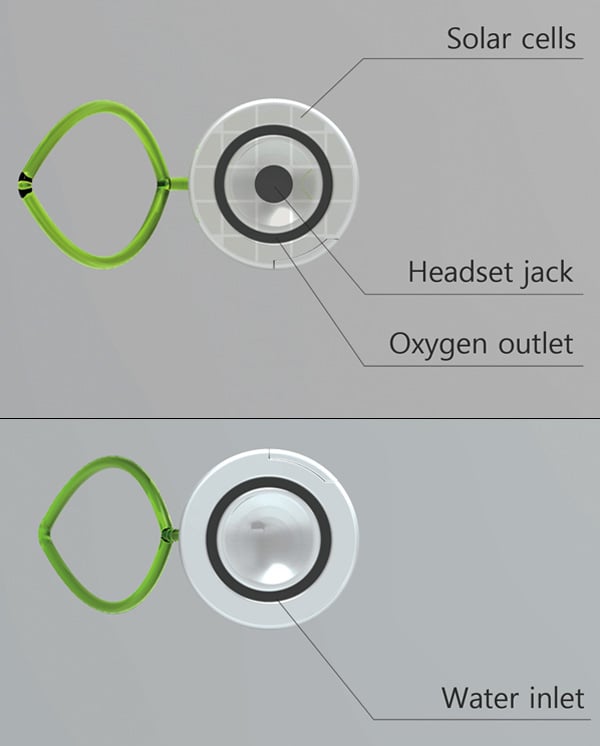
The Plantbook when rolled back into its cylindrical form gets placed inside a beaker full of water to soak it, thus generating hydrogen via the process of electrolysis and releasing oxygen. The energy required for electrolysis is provided by a solar heat plate that is affixed at the top of the device. Much like a plant, the Plantbook produces energy releases oxygen. Furthermore, the Plantbook has a strap or a hand ring affixed to the top that has a leaf-like shape with green LED; it indicates the extent to which the battery has been charged. It is incredible to see how much energy we can generate through natural means - without having to cut down trees, eat into our limited oil and coal reserves, etc. 
The Plantbook definitely seems to be a path-breaking concept.


Read More
Posted in | No comments
Older Posts Home
Subscribe to: Comments (Atom)

Popular Posts

  • Gigabyte's Wireless Laser Mouse -- ECO600
    Laser Mouse 12-month Battery. Energy Saving From Now On! GIGABYTE, a leading manufacturer of motherboards and graphics cards, is pleased to ...
  • New lithium-ion battery design that’s 2,000 times more powerful, recharges 1,000 times faster
    Researchers at the University of Illinois at Urbana-Champaign have developed a new lithium-ion battery technology that is 2,000 times more p...
  • AMD's A-Series Laptops are here, desktops in pipeline
    AMD has expanded its A-Series processor line with the first chips designed for desktops. The new chips join a lineup that includes seven mob...
  • Single-Layer Tin Could Go Beyond Graphene, Conducting Electricity with 100% Efficiency
    2D Tin Could Be Next Super Material, Say Theorists A single layer of tin atoms could be the world’s first material to conduct electricity wi...
  • Enterprise Resource Planning ( ERP )
    Enterprise Resource Planning (ERP) ERP denotes Enterprise Resource Planning that is a technique of using computer machinery to connect diver...
  • Holey Optochip First to Transfer One Trillion Bits of Information per Second Using the Power of Light developed by IBM
    IBM scientists today reported of a prototype optical chipset, dubbed “Holey Optochip”, that is the first parallel optical transceiver to tra...
  • CRM Solutions and Services
    CRM Solutions Customer Relationship Management (CRM) solutions help you to manage your customers more efficiently in an increasingly competi...
  • Fully Laser Integrated Photonics (FLIP) - A revolution in Computing Technology on the edge
    Fully Laser Integrated Photonics  (FLIP) may replace conventional electronics in a whole lot of computing and cut down computing's ever...
  • Apple and Microsoft aiming to eliminate the use of mouse...........
    The personal computer is a term that is used widely but yet not really defined. You may argue that it doesn't need to be defined as it i...
  • USRobotics introduces USB 3.0 Card Reader with dual SD slots
    USRobotics has added to its line of USB 3.0 products that currently includes a 4-port USB 3.0 Hub, 2-Port ExpressCard Adapter and 2-Port PCI...

Blog Archive

  • ▼  2013 (4)
    • ▼  November (4)
      • New lithium-ion battery design that’s 2,000 times ...
      • Single-Layer Tin Could Go Beyond Graphene, Conduct...
      • Qualcomm Unleashes High-End Mobile Application Pro...
      • Synaptic Transistor Learns While It Computes
  • ►  2012 (4)
    • ►  March (1)
    • ►  February (2)
    • ►  January (1)
  • ►  2011 (37)
    • ►  October (2)
    • ►  September (1)
    • ►  August (5)
    • ►  July (12)
    • ►  June (5)
    • ►  May (12)
Powered by Blogger.

About Me

Unknown
View my complete profile